Home

jeudi 19 janvier 2012

La sur-évaluation de la recherche


Envoyé par io2a via Google Reader :


via (titre inconnu) de Guillaume Braunstein <guillaume.braunstein@ehess.fr > le 17/01/12

Intervention de Yves Gingras dans le cadre du séminaire du CEMS-IMM


Ce que vous pouvez faire à partir de cette page :


La sur-évaluation de la recherche


Envoyé par io2a via Google Reader :


via (titre inconnu) de Guillaume Braunstein <guillaume.braunstein@ehess.fr > le 17/01/12

Intervention de Yves Gingras dans le cadre du séminaire du CEMS-IMM


Ce que vous pouvez faire à partir de cette page :


jeudi 13 octobre 2011

Le déclin de la science américaine - Le Point


Envoyé par io2a via Google Reader :


Ce que vous pouvez faire à partir de cette page :


Le déclin de la science américaine - Le Point


Envoyé par io2a via Google Reader :


Ce que vous pouvez faire à partir de cette page :


jeudi 6 octobre 2011

On being seduced by The World University Rankings (2011-12)

« Special can be beautiful »


Envoyé par io2a via Google Reader :


via GlobalHigherEd de globalhighered le 05/10/11

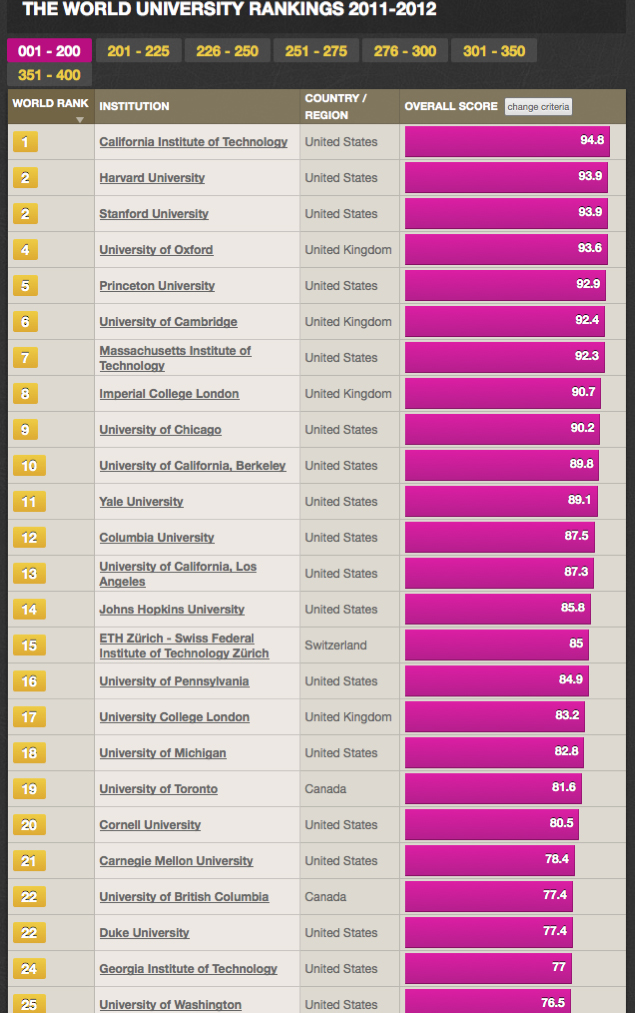
Well, it's ranking season again, and the Times Higher Education/Thomson Reuters World University Rankings (2011-2012) has just been released. The outcome is available here, and a screen grab of the Top 25 universities is available to the right. Link here for a pre-programmed Google News search for stories about the topic, and link here for Twitter-related items (caught via the #THEWUR hash tag).

Polished up further after some unfortunate fall-outs from last year, this year's outcome promises to give us an all improved, shiny and clean result. But is it?

Like many people in the higher education sector, we too are interested in the ranking outcomes, not that there are many surprises, to be honest.

Rather, what we'd like to ask our readers to reflect on is how the world university rankings debate is configured. Configuration elements include:

  • Ranking outcomes: Where is my university, or the universities of country X, Y, and Z, positioned in a relative sense (to other universities/countries; to peer universities/countries; in comparison to last year; in comparison to an alternative ranking scheme)?
  • Methods: Is the adopted methodology appropriate and effective? How has it changed? Why has it changed?
  • Reactions: How are key university leaders, or ministers (and equivalents) reacting to the outcomes?
  • Temporality: Why do world university rankers choose to release the rankings on an annual basis when once every four or five years is more appropriate (given the actual pace of change within universities)? How did they manage to normalize this pace?
  • Power and politics: Who is producing the rankings, and how do they benefit from doing so? How transparent are they themselves about their operations, their relations (including joint ventures), their biases, their capabilities?
  • Knowledge production: As is patently evident in our recent entry 'Visualizing the uneven geographies of knowledge production and circulation,' there is an incredibly uneven structure to the production of knowledge, including dynamics related to language and the publishing business.  Given this, how do world university rankings (which factor in bibliometrics in a significant way) reflect this structural condition?
  • Governance matters: Who is governing whom? Who is being held to account, in which ways, and how frequently? Are the ranked capable of doing more than acting as mere providers of information (for free) to the rankers? Is an effective mechanism needed for regulating rankers and the emerging ranking industry? Do university leaders have any capability (none shown so far!) to collaborate on ranking governance matters?
  • Context(s): How do schemes like the THE's World University Rankings, the Academic Ranking of World Universities (ARWU), and the QS World University Rankings, relate to broader attempts to benchmark higher education systems, institutions, and educational and research practices or outcomes? And here we flag the EU's new U-Multirank scheme, and the OECD's numerous initiatives (e.g., AHELO) to evaluate university performance globally, as well as engender debate about benchmarking too. In short, are rankings like the ones just released 'fit for purpose' in genuinely shed light on the quality, relevance and efficiency of higher education in a rapidly-evolving global context?

The Top 400 outcomes will and should be debated, and people will be curious about the relative place of their universities in the ranked list, as well as about the welcome improvements evident in the THE/Thomson Reuters methodology. But don't be invited into distraction and only focus on some of these questions, especially those dealing with outcomes, methods, and reactions.

Rather, we also need to ask more hard questions about power, governance, and context, not to mention interests, outcomes, and potential collateral damage to the sector (when these rankings are released and then circulate into national media outlets, and ministerial desktops). There is a political economy to world university rankings, and these schemes (all of them, not just the THE World University Rankings) are laden with power and generative of substantial impacts; impacts that the rankers themselves often do not hear about, nor feel (e.g., via the reallocation of resources).

Is it not time to think more broadly, and critically, about the big issues related to the great ranking seduction?

Kris Olds & Susan Robertson


Ce que vous pouvez faire à partir de cette page :


On being seduced by The World University Rankings (2011-12)

« Special can be beautiful »


Envoyé par io2a via Google Reader :


via GlobalHigherEd de globalhighered le 05/10/11

Well, it's ranking season again, and the Times Higher Education/Thomson Reuters World University Rankings (2011-2012) has just been released. The outcome is available here, and a screen grab of the Top 25 universities is available to the right. Link here for a pre-programmed Google News search for stories about the topic, and link here for Twitter-related items (caught via the #THEWUR hash tag).

Polished up further after some unfortunate fall-outs from last year, this year's outcome promises to give us an all improved, shiny and clean result. But is it?

Like many people in the higher education sector, we too are interested in the ranking outcomes, not that there are many surprises, to be honest.

Rather, what we'd like to ask our readers to reflect on is how the world university rankings debate is configured. Configuration elements include:

  • Ranking outcomes: Where is my university, or the universities of country X, Y, and Z, positioned in a relative sense (to other universities/countries; to peer universities/countries; in comparison to last year; in comparison to an alternative ranking scheme)?
  • Methods: Is the adopted methodology appropriate and effective? How has it changed? Why has it changed?
  • Reactions: How are key university leaders, or ministers (and equivalents) reacting to the outcomes?
  • Temporality: Why do world university rankers choose to release the rankings on an annual basis when once every four or five years is more appropriate (given the actual pace of change within universities)? How did they manage to normalize this pace?
  • Power and politics: Who is producing the rankings, and how do they benefit from doing so? How transparent are they themselves about their operations, their relations (including joint ventures), their biases, their capabilities?
  • Knowledge production: As is patently evident in our recent entry 'Visualizing the uneven geographies of knowledge production and circulation,' there is an incredibly uneven structure to the production of knowledge, including dynamics related to language and the publishing business.  Given this, how do world university rankings (which factor in bibliometrics in a significant way) reflect this structural condition?
  • Governance matters: Who is governing whom? Who is being held to account, in which ways, and how frequently? Are the ranked capable of doing more than acting as mere providers of information (for free) to the rankers? Is an effective mechanism needed for regulating rankers and the emerging ranking industry? Do university leaders have any capability (none shown so far!) to collaborate on ranking governance matters?
  • Context(s): How do schemes like the THE's World University Rankings, the Academic Ranking of World Universities (ARWU), and the QS World University Rankings, relate to broader attempts to benchmark higher education systems, institutions, and educational and research practices or outcomes? And here we flag the EU's new U-Multirank scheme, and the OECD's numerous initiatives (e.g., AHELO) to evaluate university performance globally, as well as engender debate about benchmarking too. In short, are rankings like the ones just released 'fit for purpose' in genuinely shed light on the quality, relevance and efficiency of higher education in a rapidly-evolving global context?

The Top 400 outcomes will and should be debated, and people will be curious about the relative place of their universities in the ranked list, as well as about the welcome improvements evident in the THE/Thomson Reuters methodology. But don't be invited into distraction and only focus on some of these questions, especially those dealing with outcomes, methods, and reactions.

Rather, we also need to ask more hard questions about power, governance, and context, not to mention interests, outcomes, and potential collateral damage to the sector (when these rankings are released and then circulate into national media outlets, and ministerial desktops). There is a political economy to world university rankings, and these schemes (all of them, not just the THE World University Rankings) are laden with power and generative of substantial impacts; impacts that the rankers themselves often do not hear about, nor feel (e.g., via the reallocation of resources).

Is it not time to think more broadly, and critically, about the big issues related to the great ranking seduction?

Kris Olds & Susan Robertson


Ce que vous pouvez faire à partir de cette page :


lundi 26 septembre 2011

Politique : "Le classement de Shanghai n'est pas scientifique" - La Recherch...

"La place de la France dans les palmarès mondiaux influence les réformes en cours. Ainsi « évaluer » est devenu le mot à la mode dans la recherche et l'enseignement supérieur français. Encore faut-il utiliser des indicateurs fiables et pertinents."
par Yves Gingras


Envoyé par io2a via Google Reader :


Ce que vous pouvez faire à partir de cette page :


Politique : "Le classement de Shanghai n'est pas scientifique" - La Recherch...

"La place de la France dans les palmarès mondiaux influence les réformes en cours. Ainsi « évaluer » est devenu le mot à la mode dans la recherche et l'enseignement supérieur français. Encore faut-il utiliser des indicateurs fiables et pertinents."
par Yves Gingras


Envoyé par io2a via Google Reader :


Ce que vous pouvez faire à partir de cette page :


mardi 20 septembre 2011

L'Europe va lancer son propre classement des universités - Libération


Envoyé par io2a via Google Reader :


via Delicious/io2a de io2a le 20/09/11

Le vieux continent est à la traîne dans le célèbre et controversé classement de Shanghai. Une augmentation du nombre de bourses Erasmus est également envisagée.

http://www.delicious.com Bookmark this on Delicious - Saved by io2a to - More about this bookmark


Ce que vous pouvez faire à partir de cette page :


L'Europe va lancer son propre classement des universités - Libération


Envoyé par io2a via Google Reader :


via Delicious/io2a de io2a le 20/09/11

Le vieux continent est à la traîne dans le célèbre et controversé classement de Shanghai. Une augmentation du nombre de bourses Erasmus est également envisagée.

http://www.delicious.com Bookmark this on Delicious - Saved by io2a to - More about this bookmark


Ce que vous pouvez faire à partir de cette page :


lundi 22 août 2011

Classement de Shangaï: Aix-Marseille, université jugée déjà unique, fait un ...


Envoyé par io2a via Google Reader :


via Le blog Educ de pwallez le 14/08/11

Le Centre de l'Université de Shangaï Jiao Tong University qui se charge d'établir une hiérarchie mondiale des universités selon des critères assez contestés par la communauté universitaire française a rendu public aux premières heures de la nuit son "Classement de Shangaï" 2011 (Academic Ranking of World Universities ARWU). On se souvient (voir article précédent) qu'une délégation était venue en France récemment visiter plusieurs universités en statut de PRES pré fusionnel dont Aix-Marseille qui deviendra université unique en janvier 2012. Les spécialistes du classement ont tenu compte de ce changement de taille, qui va se traduire par une signature commune Aix-Marseille  Université quant aux travaux scientifiques publiés dans les revues de renom, un des paramètres du Ranking de Shangaï.

AMU et Strabourg, déjà université fusionnée, font donc un grand bond en avant, prenant place dans la catégorie non différenciée des universités mondiales classées  entre 102 et 150. AMU s'installe dans le pelotion de tête des universités françaises (entre 4 et 6e). Les présidents des trois universités en passe de fusionner espèrent que ce sera un argument de poids pour obtenir le label IDEX dont le dossier doit être remis le 20 septembre.   Les universités de Provence (U1) et de la Méditerranée (U2) étaient les seules classées auparavant et dans le wagon des 201-300.

Les universités américaines écrasent toujours ce classement mondial avec huit établissements parmi les dix premiers.

Classement des universités françaises : http://www.shanghairanking.com/Country2011Main.jsp?param=France

La fiche complète de AMU établie par le CWCU Shangaï : http://www.shanghairanking.com/Institution.jsp?param=Aix-Marseille University


Communiqué du CWCU de l'Université de Shangaï Jiao Tong

The Center for World-Class Universities of Shanghai Jiao Tong University released today the 2011 Academic Ranking of World Universities (ARWU), marking its 9th consecutive year of measuring the performance of top universities worldwide.

Harvard University tops the 2011 list; other Top 10 universities are: Stanford, MIT, Berkeley, Cambridge, Caltech, Princeton, Columbia, Chicago and Oxford. In Continental Europe, ETH Zurich (23rd) in Switzerland takes first place, followed by Paris-Sud (40th) and Pierre and Marie Curie (41st) in France. The best ranked universities in Asia are University of Tokyo (21st) and Kyoto University (27th) in Japan.

Three universities are ranked among Top 100 for the first time in the history of ARWU: University of Geneva (73rd), University of Queensland (88th) and University of Frankfurt (100th). As a result, the number of Top 100 universities in Switzerland, Australia and Germany increases to 4, 4 and 6 respectively.

Ten universities first enter into Top 500, among them University of Malaya in Malaysia and University of Zagreb in Croatia enable their home countries to be represented, together with other 40 countries, in the 2011 ARWU list.

Progress of universities in Middle East countries is remarkable. King Saud University in Saudi Arabia first appears in Top 300; King Fahd University of Petroleum & Minerals in Saudi Arabia, Istanbul University in Turkey and University of Teheran in Iran move up in Top 400 for the first time; Cairo University in Egypt is back to Top 500 after five years of staggering outside.

The number of Chinese universities in Top 500 increases to 35 in 2011, with National Taiwan University, Chinese University of Hong Kong, and Tsinghua University ranked among Top 200.

The Center for World-Class Universities of Shanghai Jiao Tong University also released the 2011 Academic Ranking of World Universities by Broad Subject Fields (ARWU-FIELD) and 2011 Academic Ranking of World Universities by Subject Field (ARWU-SUBJECT).Top 100 universities in five broad subject fields and in five selected subject fields are listed, where the best five universities are:

Natural Sciences and Mathematics – Harvard, Berkeley, Princeton, Caltech and Cambridge
Engineering/Technology and Computer Sciences – MIT, Stanford, Berkeley, UIUC and Georgia Tech
Life and Agriculture Sciences – Harvard, MIT, UC San Francisco, Cambridge and Washington (Seattle)
Clinical Medicine and Pharmacy – Harvard, UC San Francisco, Washington (Seattle), Johns Hopkins and Columbia
Social Sciences – Harvard, Chicago, MIT, Berkeley and Columbia

Mathematics – Princeton, Harvard, Berkeley, Stanford and Cambridge
Physics – MIT, Harvard, Caltech,Princeton and Berkeley
Chemistry – Harvard, Berkeley, Stanford, Cambridge and ETH Zurich
Computer Science – Stanford, MIT, Berkeley, Princeton and Harvard
Economics/Business – Harvard, Chicago, MIT, Berkeley and Columbia

The complete listsand detailed methodologies can be found at the Academic Ranking of World Universities website at http://www.ShanghaiRanking.com/.

Academic Ranking of World Universities (ARWU): Starting from 2003, ARWU has been presenting the world top 500 universities annually based on a set of objective indicators and third-party data. ARWU has been recognized as the precursor of global university rankings and the most trustworthy list. ARWU uses six objective indicators to rank world universities, including the number of alumni and staff winning Nobel Prizes and Fields Medals, number of highly cited researchers selected by Thomson Scientific, number of articles published in journals of Nature and Science, number of articles indexed in Science Citation Index - Expanded and Social Sciences Citation Index, and per capita performance with respect to the size of an institution. More than 1000 universities are actually ranked by ARWU every year and the best 500 are published.

Center for World-Class Universities of Shanghai Jiao Tong University (CWCU): CWCU has been focusing on the study of world-class universities for many years, published the first Chinese-language book titled world-class universities and co-published the first English book titled world-class universities with European Centre for Higher Education of UNESCO. CWCU initiated the "International Conference on World-Class Universities" in 2005 and organizes the conference every second year, which attracts a large number of participants from all major countries. CWCU endeavors to build databases of major research universities in the world and clearinghouse of literature on world-class universities, and provide consultation for governments and universities.




Ce que vous pouvez faire à partir de cette page :