Envoyé par io2a via Google Reader :
via Delicious/io2a de io2a le 20/06/12
Ce que vous pouvez faire à partir de cette page :
- Vous abonner à Delicious/io2a à l'aide de Google Reader
- Suivre l'actualité de tous vos sites favoris avec Google Reader


CrossRef Labs is happy to announce the first public release of "pdf-extract" an open source set of tools and libraries for extracting citation references (and, eventually, other semantic metadata) from PDFs. We first demonstrated this tool to CrossRef members at our annual meeting last year. See the pdf-extract labs page for a detailed introduction to this new set of tools.
If you are unable to download and install the tool, you can play with a experimental web interface called "Extracto." Be warned, Extracto is running on very feeble server using an erratic and slow internet connection. The only guarantee that we can make about using it is that it will repeatedly fall over and annoy you. The weasel has spoken.
CrossRef Labs is happy to announce the first public release of "pdf-extract" an open source set of tools and libraries for extracting citation references (and, eventually, other semantic metadata) from PDFs. We first demonstrated this tool to CrossRef members at our annual meeting last year. See the pdf-extract labs page for a detailed introduction to this new set of tools.
If you are unable to download and install the tool, you can play with a experimental web interface called "Extracto." Be warned, Extracto is running on very feeble server using an erratic and slow internet connection. The only guarantee that we can make about using it is that it will repeatedly fall over and annoy you. The weasel has spoken.


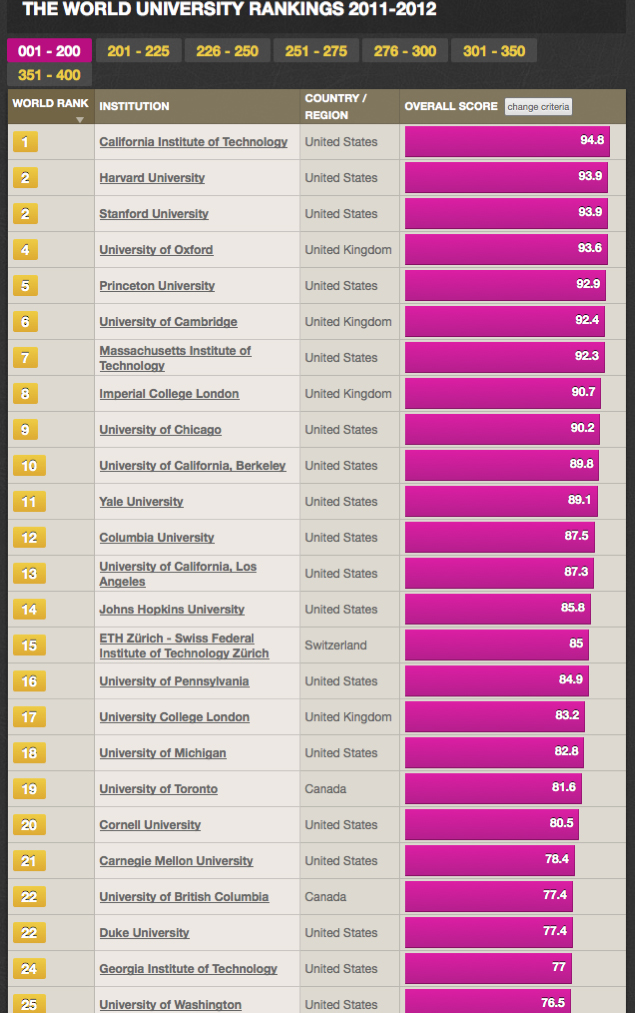
Polished up further after some unfortunate fall-outs from last year, this year's outcome promises to give us an all improved, shiny and clean result. But is it?
Like many people in the higher education sector, we too are interested in the ranking outcomes, not that there are many surprises, to be honest.
Rather, what we'd like to ask our readers to reflect on is how the world university rankings debate is configured. Configuration elements include:
The Top 400 outcomes will and should be debated, and people will be curious about the relative place of their universities in the ranked list, as well as about the welcome improvements evident in the THE/Thomson Reuters methodology. But don't be invited into distraction and only focus on some of these questions, especially those dealing with outcomes, methods, and reactions.
Rather, we also need to ask more hard questions about power, governance, and context, not to mention interests, outcomes, and potential collateral damage to the sector (when these rankings are released and then circulate into national media outlets, and ministerial desktops). There is a political economy to world university rankings, and these schemes (all of them, not just the THE World University Rankings) are laden with power and generative of substantial impacts; impacts that the rankers themselves often do not hear about, nor feel (e.g., via the reallocation of resources).
Is it not time to think more broadly, and critically, about the big issues related to the great ranking seduction?
Kris Olds & Susan Robertson


